
Quick answer: The S1000RR is BMW’s flagship liter-class superbike — devastatingly fast, but built as a road-and-track all-rounder that most owners ride on the street. The M1000RR is the homologation special: the racing-derived version with more top-end power, lighter carbon-fiber components, a higher redline, functional carbon winglets for downforce, and a race-focused chassis — at a significantly higher price. For most riders, the S1000RR is the answer. The M1000RR is for track-focused riders chasing every last marginal gain and the WSBK-bred pedigree.
At a glance, the S1000RR and M1000RR look like close cousins — same inline-four DNA, same aggressive superbike silhouette. But they’re built for different riders. This breakdown covers what actually separates them so you can figure out which one fits how you ride.
Explore our current BMW S1000RR and M1000RR inventory and find the superbike that fits your riding style, performance goals, and budget.
Think of it this way: the S1000RR is the most capable liter-class superbike BMW builds for the road-and-track rider — the one the vast majority of buyers choose. The M1000RR is BMW’s homologation special, the street-legal basis for its World Superbike racing effort, built with racing components and priced accordingly. Both share most of their core, but the M pushes every performance lever further.
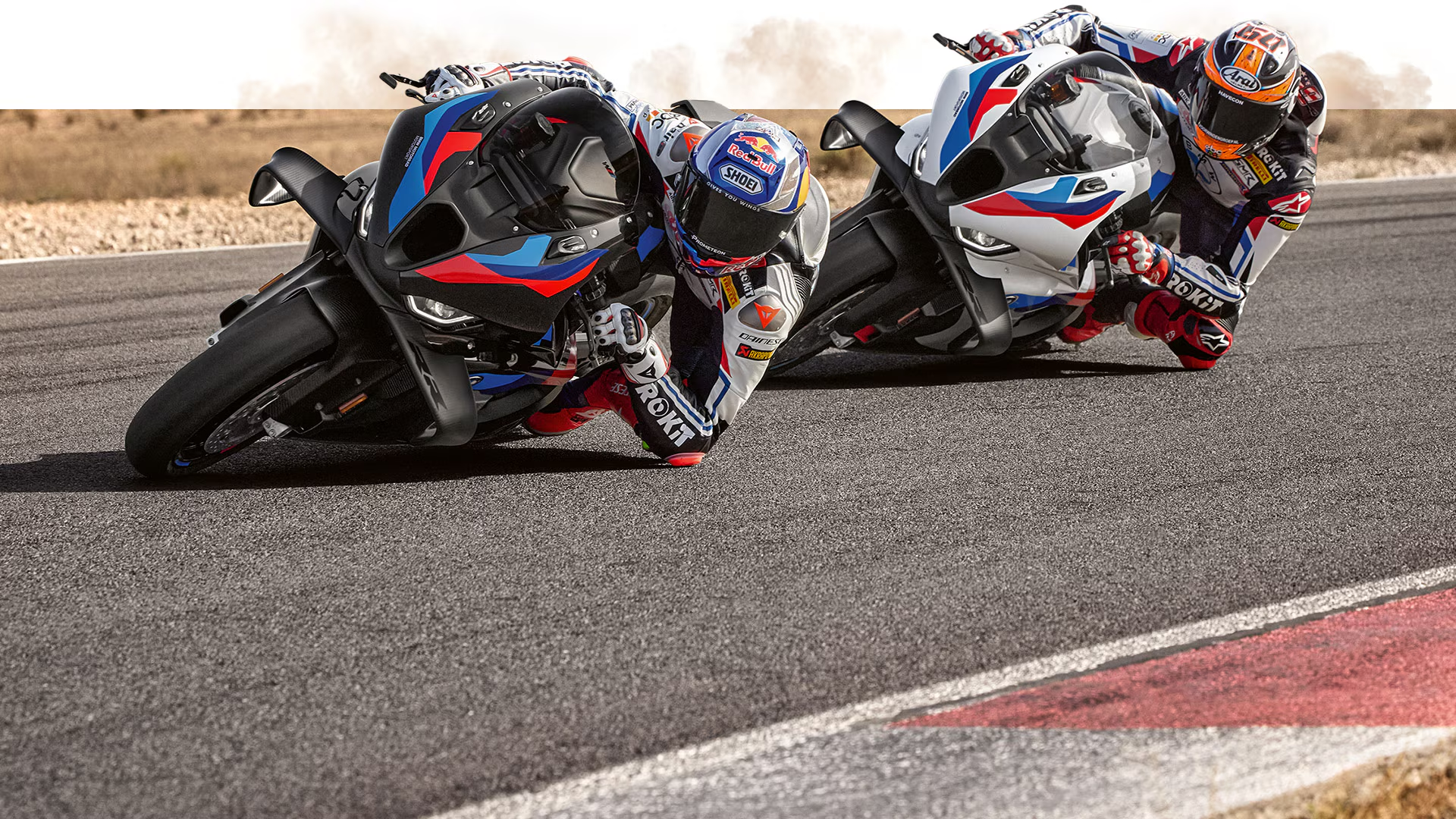
Both bikes are built on BMW’s 999cc ShiftCam inline-four. The M1000RR gets a more aggressively tuned, race-oriented version of that engine, making more peak power at higher RPM and revving higher before the limiter. The S1000RR’s engine is extraordinarily strong in its own right — its power delivery is famously linear and manageable thanks to the ShiftCam variable valve system — but the M sits above it on outright top-end output.
A note on numbers: exact horsepower figures vary by model year and market (U.S.-spec figures often differ from European ones), so rather than fixate on a specific claimed number, the reliable takeaway is that the M1000RR makes more top-end power and revs higher, while the S1000RR delivers a broad, usable powerband that most riders will find more than enough. For current, exact model-year specs, confirm with the dealer.
This is one of the M1000RR’s biggest advantages. It uses carbon-fiber bodywork and lighter components (including lighter wheels) to shed weight versus the S1000RR. Less weight helps everywhere that matters on track — acceleration, braking, and how quickly the bike changes direction through a corner. The S1000RR is no heavyweight, but the M’s materials give it a measurable edge in this area.
Both current bikes use winglets, but they’re different in scale and intent. The M1000RR’s carbon winglets are designed to maximize downforce at high speed, keeping the front planted for stability under hard acceleration and at high lean — a genuine racing aid, not a styling gimmick. The S1000RR also gets winglets (larger than earlier versions) that add meaningful downforce, along with aero refinements like brake-cooling ducts for track use. The M simply pushes the aero package further in service of outright track performance.
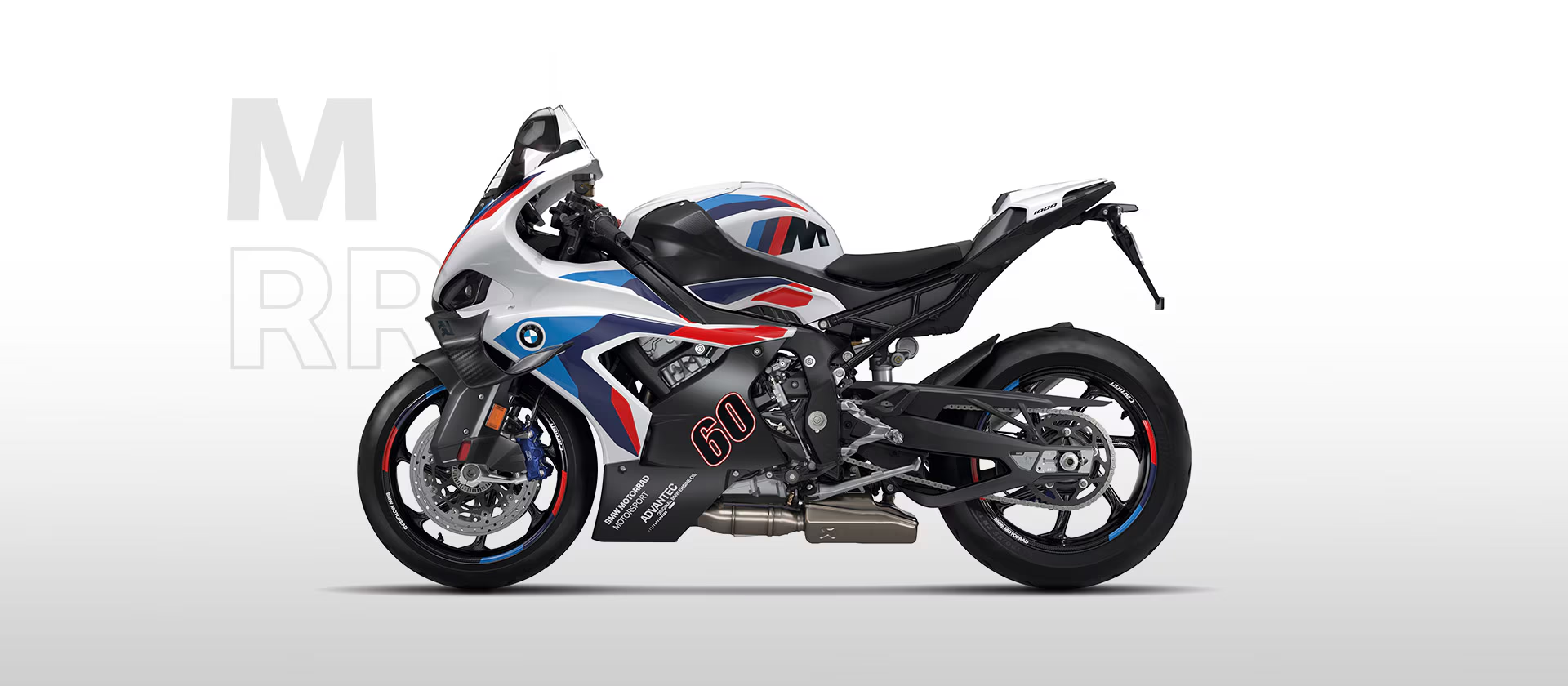
Both bikes come loaded with BMW’s rider-aid suite — dynamic traction control, cornering ABS, wheelie control, launch control, engine-brake control, and a bidirectional quickshifter, among others. The M1000RR adds race-focused chassis and suspension tuning and additional M-specific electronics and mapping aimed at extracting lap times. The S1000RR offers a poised, stable, and slightly roomier setup that’s more forgiving for road use and longer rides, while still being track-capable.
The M1000RR carries a substantially higher price than the S1000RR — it’s a homologation special with racing components, and it’s priced as one. The S1000RR delivers the overwhelming majority of real-world performance for far less money, which is exactly why it accounts for the bulk of sales. The M1000RR is a specialty machine for buyers who specifically want the race-bred version and will use (or simply value) what it offers.
Worth knowing: the S1000RR is available with an optional M Package that adds features like forged wheels, upgraded suspension settings, and M-specific styling. It closes some of the gap to the M1000RR — lighter wheels, sharper setup — without crossing into full homologation-special territory or price. For a lot of buyers who want a little more than the base S1000RR but don’t need the full M, the M Package is the sweet spot.
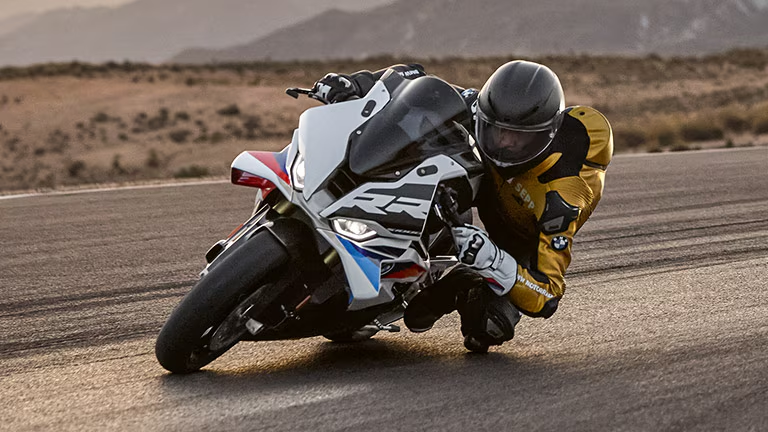
Choose the S1000RR if you:
Choose the M1000RR if you:
Consider the S1000RR with M Package if you:
There’s no wrong answer here — both are phenomenal. The question is honestly how and where you’ll ride, and how much of the bike’s ceiling you’ll actually use.
The S1000RR is BMW’s road-and-track flagship superbike that most owners ride on the street. The M1000RR is the racing-derived homologation special — more top-end power, lighter carbon components, higher redline, functional winglets, and a race-focused chassis, at a much higher price.
Yes. The M1000RR makes more top-end power, revs higher, and is lighter, giving it an edge in outright performance — differences that matter most on track and at very high speed. On public roads, much of that gap is inaccessible.
For dedicated track riders who want the lightest, most race-focused bike and value the homologation-special pedigree, yes. For most riders, the S1000RR delivers the vast majority of the performance for far less, which is why it outsells the M.
An optional package for the S1000RR that adds features like forged wheels, upgraded suspension settings, and M-specific styling — narrowing the gap to the M1000RR without the full homologation-special price.
Yes, current versions of both use winglets for downforce. The M1000RR’s carbon winglets are designed for maximum track downforce, while the S1000RR’s are larger than earlier versions and paired with aero refinements like brake-cooling ducts.
Neither liter bike is a beginner machine, but between the two, the S1000RR’s broader, more manageable powerband and more forgiving setup make it the more sensible choice for a rider stepping up — ideally with proper training and experience.
Long Beach BMW Motorcycles is a multiple-year, back-to-back #1 BMW Motorrad dealership in the USA, recognized by BMW Motorrad for excellence in sales, service, performance support, parts, accessories, and rider-focused expertise. Whether you’re drawn to the S1000RR or the M1000RR, our team can walk you through current specs, the M Package option, and which bike genuinely fits your riding.
Specs only tell you so much — sitting on both makes the choice clear. Stop by Long Beach BMW Motorcycles or reach out to our team to compare the S1000RR and M1000RR, explore the M Package, and find the superbike that fits how you ride.

While great effort is made to ensure the accuracy of the information on this site, errors can occur. Please verify all pricing and installed equipment information with a customer service representative. This is easily done by calling us or visiting us at the dealership.
We improve our products and advertising by using Microsoft Clarity to see how you use our website. By using our site, you agree that we and Microsoft can collect and use this data. Our privacy statement has more details.

Save your favorite vehicles for later viewing on your desktop or mobile devices.
Keep track of all the vehicles you've viewed for a better car shopping experience.
Narrow your search by comparing your favorite vehicles.