
Quick answer: Both share the same 895cc parallel-twin, but they’re tuned for different riders. The F 800 GS is the road-focused, more affordable, more beginner-friendly all-rounder — 87 hp, cast wheels, a lower seat, and a lower price. The F 900 GS is the off-road-focused, higher-performance version — 105 hp, over 30 lb lighter, a standard Akrapovič muffler, spoked wheels, and available Enduro Pro hardware for serious dirt. Choose the F 800 GS for street riding, commuting, and value; choose the F 900 GS if you genuinely ride off-road and want the lighter, more powerful, more capable machine.
BMW’s middleweight GS lineup gives you two closely related but distinctly different choices: the F 800 GS and the F 900 GS. They share a lot of DNA but aim at different riders. This guide breaks down exactly how they differ so you can pick the right one.
Explore our current BMW G 310 R inventory and find a lightweight, approachable motorcycle that fits your comfort, confidence, and goals as a new rider.
Both bikes are built on the same new 895cc parallel-twin engine with counterbalance shafts. But BMW tunes them differently for their intended missions. As one way to frame it: the F 800 GS speaks pavement as its first language, while the F 900 GS is fluent in dirt. Same core, different personalities.
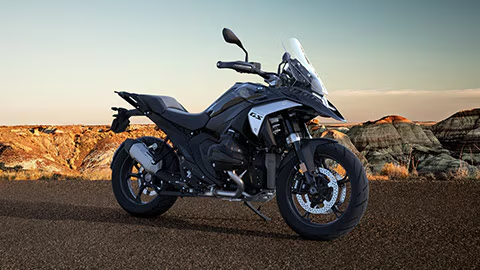
The tuning difference shows up clearly in the numbers:
The F 900 GS is the more powerful, more exciting bike; the F 800 GS delivers friendly, usable performance that’s easier for newer or more casual riders to manage.
Here’s one of the most important differences: the F 900 GS is over 30 lb lighter than the F 800 GS (around 483 lb vs. roughly 500 lb). BMW achieved this partly with a lighter plastic fuel tank and other weight savings aimed squarely at off-road riders.
On an adventure bike, weight matters enormously — especially off-pavement, where a lighter bike is easier to handle, pick up, and ride confidently on trails. This weight advantage is a big part of what makes the F 900 GS the more capable dirt machine.
This is the heart of the decision:
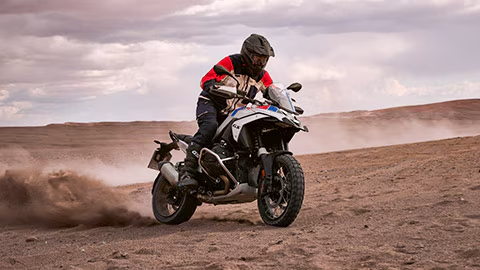
The wheels reflect each bike’s mission:
Note that the F 900 GS “comes into its own” with a few accessories — the Enduro Pro and Dynamic packages are close to must-haves to unlock its full capability, which does push the price up.
Both come well-equipped from the factory — heated grips, full LED lighting, a color TFT display, ABS Pro, and traction control. The F 800 GS is the more attainable option, starting at a lower MSRP (around $10,495 at launch), which makes it a strong value and a natural entry point. The F 900 GS adds performance, lighter weight, a standard Akrapovič sport muffler, and off-road capability — at a higher price, especially once you add the packages that make the most of it.
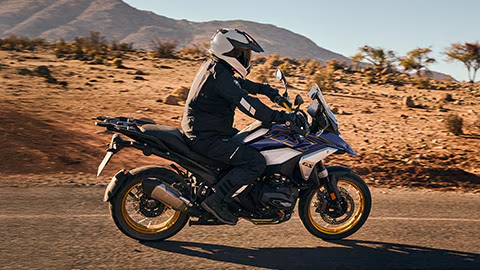
Choose the F 800 GS if you:
Choose the F 900 GS if you:
The honest guidance: if your riding is mostly pavement and occasional gravel, the F 800 GS is likely the better and more sensible choice. If you’re an adventure rider who genuinely gets in the dirt and wants a lighter, more capable machine, the F 900 GS is worth the extra investment.
Both share the same 895cc parallel-twin, but the F 800 GS is road-focused (87 hp, cast wheels, lower seat, lower price) while the F 900 GS is off-road-focused (105 hp, 30+ lb lighter, spoked wheels, standard Akrapovič muffler, Enduro Pro options).
The F 900 GS, with roughly 105 hp versus the F 800 GS’s roughly 87 hp. The F 900 GS also revs higher and has a more performance-oriented character.
Yes. It’s the more beginner-friendly of the two — road-focused, balanced, accessible, with a friendlier seat height and lower price, while still offering genuine light-adventure capability.
Yes, that’s its focus. It’s over 30 lb lighter than the F 800 GS and genuinely capable in the dirt, especially with the available Enduro Pro package. It’s a significant off-road step up from its predecessor.
The F 900 GS is over 30 lb lighter than the F 800 GS (around 483 lb vs. roughly 500 lb), achieved partly through a lighter plastic fuel tank — a real advantage off-road.
Not strictly, but the F 900 GS really comes into its own with the Enduro Pro and Dynamic packages, which unlock its full off-road capability. Factor those into the price if you’re buying it for serious dirt riding.
Long Beach BMW Motorcycles is a multiple-year, back-to-back #1 BMW Motorrad dealership in the USA, recognized by BMW Motorrad for excellence in sales, service, performance support, parts, accessories, and rider-focused expertise. Whether the road-friendly F 800 GS or the dirt-focused F 900 GS fits your riding, our team can help you choose and spec the right one.
The right choice comes down to where you actually ride. Stop by Long Beach BMW Motorcycles or reach out to our team to compare the F 800 GS and F 900 GS, talk through the packages, and find the middleweight adventure bike that fits your riding.
While great effort is made to ensure the accuracy of the information on this site, errors can occur. Please verify all pricing and installed equipment information with a customer service representative. This is easily done by calling us or visiting us at the dealership.
We improve our products and advertising by using Microsoft Clarity to see how you use our website. By using our site, you agree that we and Microsoft can collect and use this data. Our privacy statement has more details.
Save your favorite vehicles for later viewing on your desktop or mobile devices.
Keep track of all the vehicles you've viewed for a better car shopping experience.
Narrow your search by comparing your favorite vehicles.